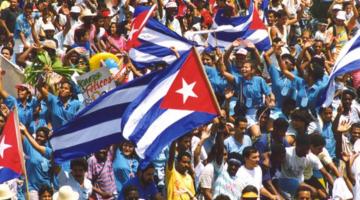
March in support of Cuban medical brigades in Kingston, Jamaica. Image: Jamaica Gleaner
Regime change is possible but not inevitable. Forces claiming to be leftist and claiming to be revolutionary must actually live up to the true meaning of those words.
Donald Trump is well known for being a liar. His lies are usually very obvious, so much so that proving his statements to be untrue is very easy to do. Yet it must be pointed out that, in his uniquely bombastic and crude way, Trump also tells the truth about his actions. “Taking Cuba in some form … whether I free it, take it, I think I can do anything I want with it, if you want to know the truth. They’re a very weakened nation right now.”
While leftists may debate whether or not the kidnapping of Venezuelan president Nicolas Maduro or the creation of a humanitarian crisis in Cuba constitute regime change, Trump provides an answer himself when he says he can do anything to Cuba that he pleases. He is said to believe he is “on a roll” as he accelerates the permanent U.S. agenda of carrying out aggressions around the world in the constant pursuit of hegemony.
The term “regime change” conjures up images of the many coups, color revolutions, and invasions that the United States has been involved in, “around 100, since 1947 alone. In the 21st century, the U.S. has invaded Iraq, kidnapped a president of Haiti, and sponsored proxy forces who successfully carried out U.S. plots in Ukraine, Libya, and Syria, to name just three nations. In the past, there were often efforts to give legitimacy to the destabilizations and interventions carried out against states around the world. George W. Bush sought and won a congressional Authorization for Use of Military Force against Iraq in 2002 and then invaded that country in 2003. In 2011, the U.S. led the passage of United Nations Security Council Resolution 1973, the “no-fly zone” resolution, which proved to be pivotal in enabling the violent overthrow of the Libyan government and the assassination of that country’s president. Trump differs from his predecessors in the speed and the intensity of his interventions and in dispensing with these niceties, which gave the U.S. some legal and diplomatic cover for its violations of international law. The current president is not telling a lie when he describes himself as being on a roll.
Trump’s siege is the culmination of more than 60 years of successive U.S. administrations devoting themselves to undoing the 1959 Cuban revolution. The CIA recruited Cuban exiles as proxies in the failed Bay of Pigs invasion in 1961. While that intervention went down to ignominious defeat, the U.S. remained undeterred in its determination. Unilateral coercive measures, sanctions, have been in place since 1960. Those measures were codified into law in the 1996 Cuban Liberty and Democratic Solidarity (Libertad) Act, known as the Helms-Burton Act, which strengthened sanctions provisions and required congressional approval before they could be lifted.
There were assassination plots meant to kill Fidel Castro. A plan to use social media, known as Cuban twitter was hatched in an effort to instigate a popular uprising. There were even chemical weapons used against Cuban agriculture, not to mention the 1962 Cuban missile crisis, which might have led to nuclear war.
There was a short respite when the Obama administration re-established diplomatic relations between the two countries, but the first Trump administration declared Cuba to be a State Sponsor of Terrorism, and Joe Biden’s administration did not remove that designation, leading Trump 2.0 to not only resume the 60-year-long war but to intensify it.
While Trump and the permanent U.S. state forces are clear, left forces are not. Some of this confusion is understandable. It is painful to see Maduro and his wife, Cilia Flores, kidnapped and to know that they are in solitary confinement in a New York City jail. It is painful to know that in Cuba, schools are closed, patients wait for medical procedures, vehicles sit idle, and food spoils because the United States siege has prevented deliveries of oil for three months and collapsed the electric grid. Who wants to think that the U.S. may finally succeed in its decades-long mission? This possibility is too awful to contemplate, but while that reaction is understandable, it must be subject to rigorous analysis.
Regime change may have a new look. Maduro is kidnapped, but Vice President Delcy Rodriguez becomes the acting president and is allowed to stay in that role. However, she may be like Maduro, the subject of a U.S. federal indictment that is used to justify his abduction. It does explain why the Bolivarian Revolution would release a statement critical of Iran, but not the U.S. or Israel. It isn’t difficult to imagine that Washington made that demand to a state that is under the gun, their gun.
The same may be true of the plot against Cuba. There is no coup, no invasion, no “boots on the ground.” But there has been a sustained attack that has extended to other countries in the region. The U.S. has even threatened them with loss of visas for their citizens and prosecutions of their officials if they did not end their participation in Cuba’s medical brigades. As expected, Jamaica, Guyana, Barbados, Honduras and other countries have ended their medical partnership with Cuba to the detriment of the lives of their own people.
Lawfare is another weapon used against Cuba. Cuba has agreed to allow Cubans living abroad, including those enemies now in the U.S., to own businesses there. As with Venezuelan leadership, the U.S. is preparing to indict Cuban officials, too. Little by little, the U.S. chips away at the revolution.
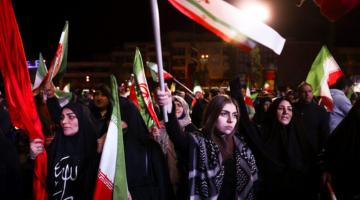
But Washington’s overreach carries a price. The military attack on Iran was expected to last for just a few days before the regime change that Trump declared to be “the best thing that could happen” took place. It has not succeeded in large part because Iran is a military power and can strike back at the U.S. and its vassal assets in the Gulf monarchies. Iran can close the Strait of Hormuz to oil traffic and upend the world financial system. The people of that country are resolute and have taken to the streets in their thousands, declaring support for their state, while the few who hoped for capitulation are the ones cowering in their homes.
Even in Venezuela, Chavista forces have been vocal in their repudiation of any acquiescence. The foreign ministry issued a rebuke to Iran, but Chavista forces were equally forceful in expressing support for Iran and, in so doing, gave inspiration and hope to millions of people who have been fighting for Venezuela’s sovereignty.
Mass action is a deterrence to acquiescence. Supporters of Cuban and Venezuelan sovereignty must find a balance between denial and defeatism. The seriousness of the onslaught has to be acknowledged and connections have to be made. It isn’t surprising that the Trump administration creates havoc around the world after the U.S./Israeli genocide in Gaza goes unpunished more than three years after it began. U.S. allies are puppets who are also under pressure from the zionist lobby. They didn’t stand up to Biden, and of course, they didn’t resist Trump either.
Millions of people stand with the Palestinian people, but they are also under the gun of prosecution and persecution. The reliance on electoral systems is doomed to failure in states run by political parties that are all subservient to imperialist systems. The U.S. Congress does nothing to stop Trump because most of its members are either in agreement regarding these policies or are cynics who will move in whatever direction the political winds may blow. Expecting democrats to stop a republican brand of imperialism is to be on a fool’s errand.
Venezuelans are speaking up against their captive government. In Jamaica, the people made clear their anger after their government succumbed to U.S. pressure tactics. A gratitude walk was held as marchers chanted, “We love Cuba,” “Bring back the nurses,” “Bring back the doctors,” and “Jamaica loves Cuba.”
Revolution can only be sustained in revolutionary ways. The shock of the attacks on Venezuela and Cuba and Iran has created disorientation and demoralization, but those reactions have to be shaken off. Nations may be targeted by Washington, but that does not mean that silence is the proper response. Mexico could send oil to Cuba in defiance of U.S. dictates, but won’t unless there is pressure from below. A Russian oil tanker was said to be on its way to Cuba, but for some reason never arrived. The countries that have the power to resist must be confronted when they don’t. Russia and China cannot be allowed to critique the U.S. and then withhold their all-important veto power as permanent members of the U.N. Security Council without hearing howls of protest around the world.
Regime change is the goal of the U.S. state, but it doesn’t have to be inevitable. People who have been calling themselves revolutionary must now prove their bona fides by acting in solidarity with one another. They cannot allow fence-straddling liberals to claim to be on the left. They cannot march with “No Kings” knowing that it amounts to nothing more than a Democratic Party voter drive. And they may have to confront the governments they have viewed as friends and allies. Washington is not fated to get its way, but it will unless revolutionaries live up to that name.
Margaret Kimberley is the author of Prejudential: Black America and the Presidents. You can support her work on Patreon and also find it on Twitter, Bluesky, and Telegram platforms. She can be reached via email at margaret.kimberley@blackagendareport.com.

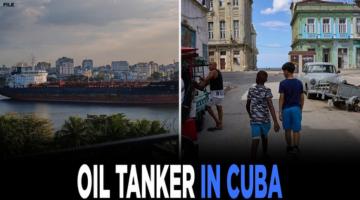
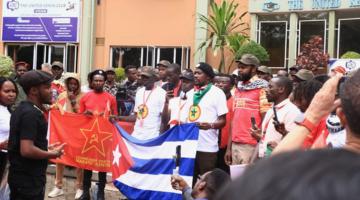 With the economic strangulation of Cuba by the United States, African progressive organizations and movements are calling for broader continental solidarity.
 Most of the world would be at greater ease if Iran had a nuclear bomb.