28-year-old mother, Josseli Barnica, died after miscarrying her second child when the hospital refused to provide an abortion due to state law. © Barnica Family/ProPublica
Black women, already leading in maternal mortality rates, are now at even greater risk of complications and death as more states impose stricter abortion laws.
The Dobbs v. Jackson Women's Health Organization decision by the U.S. Supreme Court in 2022, which overturned Roe v. Wade, has profound implications for Black women. The decision effectively removed the federal constitutional right to abortion, allowing states to set their own abortion laws. It denies women the human right of bodily autonomy, a cornerstone of self-determination.
The concept of “States Rights” emerged in debates over the balance of power in the U.S. Constitution (1787), a strong central government versus states' rights to guard against “federal overreach.” States' rights were central to arguments made by Southern states to justify enslavement and secession from the Union, claiming the federal government had no authority to interfere with enslavement within their borders. Federal efforts to enforce civil rights and suppress racial violence are still resisted by states invoking “states' rights.”
It must be noted that it was not that long ago that Black women were the subject of experimentation and forced sterilization. In 1813, enslaved Black women, without anesthesia, were experimented on by Lancaster County, South Carolina’s James Marion Sims, “The Father of Gynecology.” Later, one of my mentors, ACLU Pro Bono Lawyer Edna Primus, was persecuted by the South Carolina Bar in 1977 when she challenged South Carolina's policy of sterilizing certain women as a condition of receiving welfare.
In 2014, North Carolina passed a law to pay compensation to some of the more than 7,000 people in North Carolina — many poor, many African-American, many disabled — who were sterilized between 1929 and 1976 in one of the country's most aggressive eugenics programs.
In 2020, an 18-month bipartisan investigation by the Senate's Permanent Subcommittee on Investigations reviewed allegations that women detained by U.S. Immigration and Customs Enforcement (ICE) at the Irwin County Detention Center in Ocilla, Georgia, had endured medical neglect, lax coronavirus mitigation policies, and questionable procedures, including hysterectomies.
The Dobbs decision has exacerbated the longstanding abuse of Black women's bodies and the continuing maternal health crisis Black women already face, Black women are three times more likely than white women to die from pregnancy-related causes, even before Dobbs. The increase in state-level abortion bans is expected to worsen these disparities, as healthcare providers often delay necessary care due to fear of legal repercussions.
This climate particularly endangers those in marginalized communities, especially Black women, who already face barriers such as systemic racism and socioeconomic inequities in accessing medical care. Many states that implemented or expanded abortion restrictions post-Dobbs are in the South, where a large proportion of the Black population resides. For Black women in these regions, accessing abortion services may require traveling long distances incurring transportation and lodging costs many cannot afford. Legal risks and stigma in restrictive states may discourage seeking necessary care.
Amber Thurman, for example, was one of the first reported cases of a preventable death linked to post-Dobbs abortion bans. Amber Thurman (Georgia), a young mother, died of sepsis after doctors delayed performing a necessary dilation and curettage (D&C) procedure following a miscarriage. The delay was attributed to concerns about the legality of the procedure under Georgia's abortion restrictions.
Porsha Ngumezi (Texas): Porsha bled to death after doctors hesitated to perform a D&C to manage a miscarriage. Medical experts reviewed her case and concluded that timely intervention could have saved her life. The delay stemmed from fear of legal repercussions under Texas's abortion laws.
Nevaeh Crain (Texas): This 18-year-old died after making multiple visits to emergency rooms where care was delayed while doctors confirmed "fetal demise." She is among several Texas women who have died due to hesitation in providing care amid restrictive abortion policies.
These stories underscore the consequences of restrictive abortion laws that delay or deny critical medical interventions. Black women, disproportionately affected by systemic inequities in healthcare access, are particularly vulnerable under these new legal and medical landscapes.
The full scope of cases involving Black women who have died from preventable complications linked to post-Dobbs abortion bans is not yet fully documented or consistently reported. Comprehensive tracking of such cases is complicated by disparities in reporting, stigma, and systemic barriers faced by affected communities.
Reports from advocacy groups and public health studies are critical to identifying additional cases. Further, data collection and analysis are needed to understand the broader impact on Black women's health post-Dobbs. This may become ever more difficult and needed if the Trump administration gets its way and ends data collection by race. Black women's lives are then placed at even greater peril by Dobbs abortion bans and otherwise.





 The ceasefire brings a sense of relief but not safety. Iran showed that the empire is not invincible, but the US commitment to the doctrine of hegemony has not changed.
 Keir Starmer and Trump are putting on a puppet show for the cameras. Behind the scenes, Britain remains a junior imperialist partner working for the destruction of Iran.
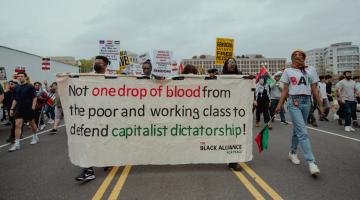 The Black Alliance for Peace marks nine years of fighting against U.S. imperialist brutality. Now the movement must transform imperialist wars into people's wars for liberation.
 The war on Iran is part of a class war against any country that refuses to open itself up for foreign profit. Understanding Iran means seeing its fight as part of the same struggle that defines the…
 “The chickens have come home to roost,” one resident said. “Our exact fears have come true.”