Revisiting a 1974 editorial on Black women and the international struggle against patriarchy, racism, imperialism, and capitalism on International Women’s Day.
To mark International Women’s Day, The Black Agenda Review is pleased to reprint “Dedicated to Women in Struggle,” an editorial from a 1974 special issue of the newsletter African Agenda: A Voice of Afro-American Opinion. African Agenda was published from 1972 to 1977 by the African-American Solidarity Committee, a Chicago-based coalition of Black radicals committed to the anti-imperialist struggles in Africa, the Caribbean and Latin America, the Middle East, and Asia, and to the fight for Black rights within the United States.
The purpose of African Agenda was “to propagate the ideas of the African-American Solidarity Committee, and to discuss the social, political, economic, and cultural ideas that affect the Afro-American community.”As such, its pages covered Black labor and anti-imperialism, the independence movements in Angola, Zimbabwe, and Mozambique, and elsewhere, Zionism and the question of South Africa, Africa and the Socialist bloc countries, and the social and economic conditions of the African American community. Run on a volunteer basis, African Agenda began as a four page-monthly newspaper. Significantly, articles in African Agenda were unsigned and anonymous. After the publication folded, its editorial board was revealed to have included Chicago educators and activists Otis Cunningham, Prexy Nesbitt, Harold Rogers, Linda Rae Murray, and Aisha Ray.
The February-March, 1974 issue included essays on the struggles of women in South Africa, Guinea-Bissau, and the United States. The editors published a report on the 1973 All-African Women’s Conference, a comment on the upcoming UN-designated International Year of the Woman (1975), and an essay on Vietnamese women and anti-imperialism. They also ran a conversation with Black Communist worker and organizer Sylvia Woods, and posted a list of recommended books, one of which was Lenin’s The Emancipation of Women.
In “Dedicated to Women in Struggle,” the authors write: “In this issue of the African Agenda, the special significance of Afro-American women is honored in light of the importance and meaning of International Women’s Day. March 8th is not just a special day for women; the other 364 days of the year should also be days that we struggle for the equality of women in our society in a unified fight against capitalism.” Five decades later, that struggle and fight continues. “Dedicated to Women in Struggle” is reproduced below.
Dedicated to Women in Struggle
African Agenda
On March 8, 1974, women and men in the United States and around the world paid special tribute to International Women’s Day. In 1910 at the International Socialist Congress of the Second International, Clara Zetkin, a German revolutionary, proposed that March 8th be a day of tribute to working women throughout the world. The initiative for this proposal came from the demonstrations of the women needle workers of New York City in 1908 who were seeking to organize the first needle trade union.
All over the world, women are playing leading roles in the fight against imperialism and the social, political and economic oppression heaped upon them. In Africa, this is especially true of women in such organizations as the Congolese Women’s Organization of the People’s Republic of the Congo, the United Women of Tanzania and the Center for the Promotion of Women in the Republic of Guinea who are equal with men in the fight to rid their countries of imperialist domination. The part that women play in the liberation movements is especially important since they are directly on the front line of the battle against Portuguese colonialism and imperialism. Such South African women of the African National Congress as Winne Mandela now facing a jail sentence, Lilian Ngoyi, former President of the ANC Women’s League, and Florence Mophosho, one of the leaders for Angela Davis Freedom in Africa, and the women of the PAIGC, FRELIMO, SWAPO, MPLA AND ZAPU, face direct physical abuse at the hands of the Portuguese and South African aggressors.
International Women’s Day takes on added significance this year because of the courage and leadership displayed by the women of Vietnam who along with their men successfully repulsed United States military aggression. Their struggle against U.S. domination and the contributions of such outstanding women as Madame Nguyen Thi Binh, Foreign Minister of the Provisional Revolutionary Government of South Vietnam, is an inspiration not only to women, but to all people who are fighting monopolies and imperialist exploitation. Vietnam is a shining example of the contributions and the supreme sacrifices of women involved in struggle and completely dismantles the unfounded capitalist propaganda about the inferiority of women.
In the U.S., Afro-American women are among the most exploited and suffer four forms of oppression: 1) they are exploited as members of the working class; 2) They are oppressed racially; 3) as women, and 4) as a nationality. At the same time, they are the least recognized and honored for their contributions to the struggle of the Afro-American community.
The history of the social democratic struggle of Afro-Americans in this country has shown that Afro-American men and women have struggled together in the fight against national and class oppression. However, male supremacy within our ranks still prevents the full equality of women in our struggle. Our struggle is still lacking the consistent advancement of the full equality of Afro-American in the struggle against capitalist exploitation. This problem which hinders the development of women, must be combatted together with men. Capitalist exploitation imposes a heavy burden on all of us and requires a unified struggle free of the bourgeois social ideology which imposes restrictions on the contributions that women should make to the struggle for liberation. Our liberation depends on Afro-American women playing new and flexible roles. The development of our struggle can be measured in part by the degree to which Afro-American women are participating in the total fight against monopoly capitalism.
In this issue of the African Agenda, the special significance of Afro-American women is honored in light of the importance and meaning of International Women’s Day. March 8th is not just a special day for women; the other 365 days of the year should also be days that we struggle for the equality of women in our society in a unified fight against capitalism.
African American Solidarity Committee, “Dedicated to Women in Struggle,” African Agenda, 3 no. 2 (February & March, 1974). Source: Chicago Anti-Apartheid Movement Collection, Columbia College Chicago.



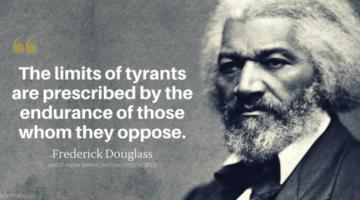 The ceasefire brings a sense of relief but not safety. Iran showed that the empire is not invincible, but the US commitment to the doctrine of hegemony has not changed.
 Keir Starmer and Trump are putting on a puppet show for the cameras. Behind the scenes, Britain remains a junior imperialist partner working for the destruction of Iran.
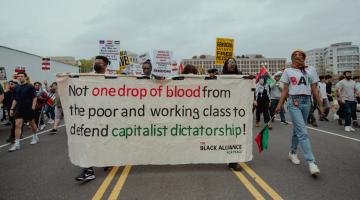 The Black Alliance for Peace marks nine years of fighting against U.S. imperialist brutality. Now the movement must transform imperialist wars into people's wars for liberation.
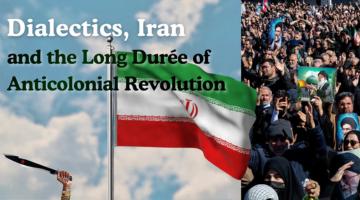 The war on Iran is part of a class war against any country that refuses to open itself up for foreign profit. Understanding Iran means seeing its fight as part of the same struggle that defines the…
 “The chickens have come home to roost,” one resident said. “Our exact fears have come true.”