The United States operates as an internal colonial system. Black communities are treated like colonized territories, and the white working class is used as a tool to enforce that control.
Originally published in Hood Communist.
The racially organized nature of space, evident in structures like the U.S. South’s plantation economies or the structural location of Black populations, is not accidental but a direct product of the colonial division of labor. Drawing on Huey P. Newton’s theory of intercommunalism, the concentration of Africans and Black people in proximate, resource-starved communities stems from the historical development of the U.S. intercontinental economy, shaped by competing colonial nations, plantation agriculture, and later industrialization. As internal class and racial struggles intensified, the ruling order responded with neoliberal austerity and internal colonialism functionally equivalent to neocolonialism within U.S. borders. Simultaneously, this domestic process unfolded alongside the intensification of global class struggle after World War II. Thus, racially segregated spaces and labor hierarchies are not remnants but active mechanisms of primitive accumulation, organized by capital to contain surplus populations, suppress revolt, and reproduce social structure across both national and international scales.
Internal colonialism provides an important framework for understanding the persistent racial inequalities and structures of oppression in the United States. Unlike traditional colonialism, which involves the exploitation of distant territories across oceans, internal colonialism refers to the systematic exploitation of racialized groups within the boundaries of a single nation-state that is developed from a settler colony. This model creates a relationship between dominant and subordinate groups that mirrors the classical colonial relationship between metropole and colony, complete with economic exploitation, political disenfranchisement, and cultural and material domination. Internal colonialism is a key form of social control, which refers to the various mechanisms through which societies ensure conformity to dominant values and norms. Social control can be either formal (through laws and official regulations) or informal (through customs, norms, and expectations). When these two concepts are combined, we can objectively see how racialized groups in the United States have been subjected to colonial exploitation maintained through sophisticated social control mechanisms, including the strategic incorporation of the white working class as instruments of racial management. This essay explores how the colonial division of labor functions as a mechanism of ongoing primitive accumulation, or accumulation by dispossession, under internal colonialism, whereby the United States government has historically activated the white working class as a social control mechanism against targeted racialized groups, maintaining the internal colonial relationship in the U.S.
Internal Colonialism as a Colonial Division of Labor
Within the framework of the colonial division of labor, chattel slavery in the United States represents the foundational manifestation of internal colonialism. Characterized by a racialized hierarchy in which colonized populations are forcibly relegated to the most exploited positions, stripped of legal personhood, and subjected to extra-economic coercion to extract surplus value, slavery functioned as both an economic system of exploitation and a comprehensive mechanism of social control. Enslaved Africans were reduced to property status, denied basic human rights, and subjected to brutal disciplinary measures to maintain the racial hierarchy. The slave system created the racial system positioning Africans at the bottom of the social order, establishing patterns of exploitation that would persist long after emancipation into capitalist racism. Slavery also served to prevent class solidarity between paid and unpaid laborers. By offering psychological and material advantages, plantation owning aristocrats created a divided working class that rarely united across racial lines to challenge the colonial order. Unchallenged, the planter class developed into a burgeoning capitalist and imperialist ruling class in the 19th century.
Following emancipation, Jim Crow segregation emerged as a new form of internal colonialism that maintained racial hierarchy through legalized discrimination and terror. The Jim Crow system created a racialized social order that economically exploited Africans captured in America through sharecropping arrangements that kept them in perpetual debt, excluded them from well-paying jobs, and prevented political participation through voter suppression tactics. The system of Jim Crow also continued the practice of systemic genocide that carried over from the period before the Civil War. This period also witnessed the systematic exploitation and extermination of indigenous nations in the Southwest, particularly in agricultural regions like South Texas, where Tejano ranchers were displaced by Euroamerican settlers who transformed the region into an agricultural empire built on cheap Mexican labor. The exploitation of ethnic groups by the white, wealthy planter class was maintained through debt peonage, voter suppression, and Jim Crow regulations that maintained African colonial subordination.
The internal colonial control of African people in the U.S., engineered during slavery, did not cease with emancipation but was strategically reconfigured through the Black Codes and the convict lease system. These mechanisms effectively criminalized African existence, arresting people for vagrancy or petty offenses and then selling their labor to private interests, creating a continuous pipeline of state-sanctioned, captive African labor for industrial and agricultural production. This period solidified the economic function of the internal colony: to maintain what Dr. Charisse Burden-Stelly calls a sub-proletariat of workers beneath the traditional proletariat, denied even the most basic labor protections and legally subjected to extreme exploitation. Simultaneously, this exploited class was often managed by a paternalistic bourgeois philanthropy, where northern industrialists and so-called benefactors funded segregated Black communities and institutions not for liberation but to produce a racially asymmetrical development. This combination of outright terror, economic coercion, and managed containment established the blueprint for the racial capitalist order that Jim Crow would later codify into law.
The rigid, legally enforced apartheid of Jim Crow, while effective for a time, ultimately produced its own grave-diggers in the form of the massive, sustained resistance that developed in the period of the Civil Rights and Black Power movements. These struggles, which directly challenged the economic exploitation and political subjugation of the internal colony, successfully dismantled the legal architecture of Jim Crow. However, the capitalist ruling class, faced with this revolutionary threat to its established order of social control and cheap labor, did not simply capitulate; it engineered a new, more adaptable system of containment. In what can be understood as a counter-revolutionary response to Black liberation movements, the U.S. settler-colonial state began to strategically develop a much more sophisticated and expansive mass prison system in the 20th century. This carceral apparatus became the primary mechanism for regulating the colonized African population, criminalizing poverty and resistance, effectively disenfranchising millions through felony convictions, and creating a new system of legalized exploitation through prison labor. Thus, the prison industrial complex emerged not as a departure from internal colonialism, but as its modern, evolved form, maintaining the same core functions of controlling Black labor, neutralizing political threat, and upholding racial capitalist order well into the civil rights period.
The White Working Class as a Social Control Mechanism
The strategic incorporation of the white working class into America’s racial hierarchy must be understood as a fundamental bourgeois strategy for maintaining capitalist control. The granting of psychological and material privileges to white labor functions to fracture the working class and prevent the development of a unified class consciousness. By offering a perceived elevated status, the ruling class secured the consent of white workers to a system that exploits them economically, while simultaneously enabling the super-exploitation of racialized communities who are relegated to a lower tier of the labor market. This created sub-proletarization of the working class, weakening collective bargaining power and ensuring a stable, low-wage workforce that maximized capitalist profit.
Imperialism operationalizes the crisis and actively generates a flow of cheapened, vulnerable labor into the United States. This process is a direct continuation of the settler-colonial logic that required the displacement and genocide of indigenous populations and the importation of enslaved labor to build its economy. The border now functions as a mechanism of coercion by the bourgeois state to manage and regulate this imported labor pool, ensuring its availability for super-exploitation.
Furthermore, this imported labor serves a critical function in maintaining social control within the imperial core. By creating an ultra-exploitable section of the proletariat, often without legal protections, the system further depresses wages and provides a new scapegoat for economic crisis. This imperial-scale “divide and rule” tactic directs the frustrations of the domestic working class toward immigrants and racialized people, rather than toward the capitalist class itself. Critically, this constant influx of cheapened labor, defined by the free market owners, actively defines and reinforces the internal colony within the U.S. by ensuring a permanent, racialized underclass. This group is subjected to external political and economic control, serves as a reservoir of surplus labor, and is maintained by force and ideology, thereby perpetuating the colonial relationship that has always underpinned the American political economy.
The very same structural logics that engineered this internal colonial system are driving American capitalism and imperialism, revealing them to be not separate phenomena but interconnected parts of a whole system of accumulation and control. The ruling class’s strategy of dividing labor along racial lines to suppress wages and prevent organized resistance is not solely confined within the nation’s borders; it is exported globally through imperialist policy. Just as the ruling class developed the labor aristocracy to manage the internal colony, imperialism creates global hierarchies that designate entire nations as peripheral zones for exploitation, destabilizing them to create a controllable flow of cheap labor (Wallerstein, Amin). This demonstrates that the exploitation of racialized populations abroad and the management of racial hierarchies at home are engineered by the same capitalist imperative: to fracture the global proletariat, create ever-larger reservoirs of exploitable labor, and secure the conditions for maximum profit extraction. The internal colony and the imperial periphery are thus twin products of a single, coherent system, both serving to maintain the power of the capitalist class by ensuring that no unified challenge to its dominion can ever fully coalesce.
Gentrification as Accumulation by Dispossession
The internal colonial thesis, which frames the relationship between the dominant white society and Black communities within the U.S. as one of colonial subjugation and economic extraction, is challenged by certain Marxist analyses that argue classic colonies are defined by their centrality to the capitalist core’s accumulation process as suppliers of raw materials and cheap labor for commodity production. These critics contend that while Black America is brutally exploited and oppressed, its role is not structurally analogous to that of a peripheral colony in a global empire, but is instead a uniquely racialized product of the domestic class structure. However, the process of gentrification presents a potent counterpoint to this dismissal, revealing a direct and systematic mechanism of wealth transfer that mirrors colonial extraction.
Historically, Black neighborhoods have been systematically devalued through state and private-sector practices like redlining, disinvestment, and the withholding of municipal services, which artificially depress property values and destabilize communities. This engineered devaluation creates a speculative frontier, where external capital often backed by state subsidies and financial institutions can acquire assets at low cost, subsequently redevelop and rebrand the area, and generate enormous profits through rising rents and real estate sales. This cycle does not merely represent market development, but a coordinated transfer of wealth and territory: it displaces Black residents, seizes communal assets built despite systemic neglect, and redirects future economic flows to white investors, developers, and affluent newcomers. Thus, through the very channels of real estate, finance, and state-sanctioned urban policy, a colonial logic operates domestically not by extracting primary commodities for industrial production, but by extracting land, equity, and potential wealth from a racially demarcated population, converting segregated spaces into vehicles for capital accumulation for the dominant society. In this light, gentrification is not an aberration, but a contemporary form of internal colonial appropriation, where the metropolis economically exploits its internally constructed periphery through controlled destabilization and asset stripping.
This process of gentrification is, in fact, a direct continuation of the foundational settler-colonial logic that has structured the United States from its inception: the displacement of marginalized people from land to facilitate its acquisition and profitable redevelopment by the dominant society. The original settler-colonial project operated through the violent removal of Indigenous peoples from their territories, which were then surveyed, parceled, and converted into private property and capital for white settlers. The system of racial slavery subsequently transformed Black people themselves into capital-producing property, while also barring them from the land-based wealth accumulation afforded to whites. After the formal end of slavery and segregation, the spatial containment of Black communities within redlined urban frontiers created a modern iteration of this dynamic.
Gentrification reactivates the core settler-colonial cycle: first, a targeted community is systematically devalued and destabilized (mirroring the fabrication of wasteland narratives about Indigenous territories), creating a ripe condition for seizure. Then, external actors, developers, financiers, and a new class of affluent, predominantly white settlers mobilize capital and state power to displace the existing population, not through outright military force, but through economic coercion and policy. Finally, the land itself is improved and reincorporated into the dominant economy, generating wealth and status for the newcomers while severing the displaced community from its historical place, social networks, and potential for intergenerational equity. Thus, the trajectory from frontier clearing and homesteading to urban redlining and speculative reinvestment reveals a consistent thread: the racial order in the U.S. continually recreates forms of internal frontiers, where the land and lives of subjugated groups are rendered vulnerable to extraction and repossession, ensuring that the fundamental settler-colonial imperative of land transfer and capital accumulation adapts to the contours of the modern urban political economy.
The Garrison State as Internal Colonial Rule
To maintain this internal colonial relationship in the 21st century, the U.S. state and capital have developed a sophisticated arsenal of control, seamlessly blending hard and soft power tactics. The modern iteration of U.S. capitalism has evolved into a sophisticated system of internal domination that extends both within and beyond its borders, reinforcing a state of hyper-surveillance and social control. This is manifested in a white supremacist capitalist imperial state empowered by an infusion of private capital selling surveillance technology to both the state and the public, who concede their privacy in exchange for a perceived security that is fundamentally aimed at monitoring racialized populations.
Within the imperial core, a parallel process of assimilation targets Black and othered populations, coercively integrating them into the ideological project of whiteness. This is exemplified by an internal comprador class and an aspirational Black petite bourgeoisie that adopts compromising postures toward white civil society, seeking security and status through conditional inclusion. On an individual level, this also manifests as a depoliticized pursuit of survival, simply trying to live a life devoid of political consciousness, which functions as a tacit acceptance of the prevailing order. These postures, from active collaboration to apolitical survival, effectively neutralize revolutionary potential from within the oppressed group itself, fragmenting collective power and bolstering the very system of control that necessitates a domestic garrison force.
This internal control is further bolstered by soft-power tactics that propagandize and quell revolutionary potential; the white working class is offered a pittance of psychological wage through the strategic, often superficial, adoption of multiculturalism, DEI, and NGO-led single-issue activism, which misdirects genuine struggle into manageable reforms that ultimately buttress the imperialist capitalist white supremacist state. Simultaneously, the state has deliberately flooded specific areas with firearms, cultivating an armed and fearful white and politically white populace primed to function as a garrison force against internally colonized African populations and other racialized groups. The domestic garrison state functions as a direct response to the threat of class solidarity, preemptively fracturing potential unity.
Dismantling the Colonial Division of Labor
This unity could arise from the shared material conditions created by capitalism’s systemic refusal to distribute resources equitably. Ultimately, the U.S. political project is a deliberate one, prioritizing capital accumulation over the genuine development of human well-being.
Yet under neoliberalism and neocolonialism, an asymmetrical economic model has emerged within the African and Black population located inside the imperial core. Too often, this population has come to view itself as fundamentally distinct from and even opposite to African and Black communities living on the periphery and in the Global South. This perceived opposition is not accidental. It reflects a deep misunderstanding of the historical process that unfolds with imperialism and capitalism. Rather than seeing their condition as consistent with the exploitation faced by the colonized and super-exploited majority worldwide, many in the core adopt frameworks of exceptionalism, individual mobility, or relative privilege that obscure the shared enemy: a global capitalist system that extracts value from life everywhere.
This isolation is articulated and reinforced by the internal colonial structures that persist within the metropole, particularly through the colonial division of labor. That division assigns different segments of the colonized population to distinct economic roles, creating a hierarchy of rewards that fragments political consciousness. Some Black workers gain access to better wages or symbolic inclusion, while others are channeled into precarious labor, incarceration, or surplus populations. The result is a fractured political identity that mistakes proximity to the ruling class for genuine liberation, and that loses sight of the longer arc of anti-colonial and anti-capitalist struggle.
To break this isolation, Africans and Black people within the imperial core must actively reconnect with our shared history of opposing the ruling class not as a nostalgic memory, but as a living political practice. We must be clear about where we are currently in that struggle: still inside the belly of the beast, still subject to the same imperial logic that drives militarism, dispossession, and forced migration, even if its local expression is more mediated by welfare state concessions or consumer credit. Organizing collectively means refusing the false choice between assimilation and marginalization, and instead building communities that directly oppose the internal structures that reproduce social relations based on individualism, competition, and subjective atomization.
Those subjective factors, the internalized values of upward mobility, respectability, and possessive individualism, are precisely what prevent the holistic development of our people. They train us to see our liberation as a private achievement rather than a collective transformation. What is needed, then, is a shift from a politics of individual advancement to an organized structure that addresses the development of a shared humanity. That structure must be anti-capitalist in its logic, democratic in its practice, and oriented toward the transition to socialism not as an abstract ideal, but as the only material framework capable of distributing resources equitably, ending the colonial division of labor, and finally uniting Black struggle across the internal and external colonies.
Bibliography
- Tricontinental: Institute for Social Research. (2021). Dependency and super-exploitation: The relationship between foreign capital and social struggles in Latin America (Dossier No. 67).
- Amin, S. (1974). Accumulation on a world scale: A critique of the theory of underdevelopment (B. Pearce, Trans.). Monthly Review Press.
- Burden-Stelly, C. (2023). Black scare / red scare: Theorizing capitalist racism in the United States. University of Chicago Press.
- Newton, H. P. (2023). Revolutionary intercommunalism. Huey P. Newton.
- Rodney, W. (2018). How Europe underdeveloped Africa (Rev. ed.). Verso Books. (Original work published 1972)
- Bin Wahad, D., Abu-Jamal, M., & Shakur, A. (1993). Still Black, still strong: Survivors of the U.S. war against black revolutionaries. Semiotext(e)
- Foner, P. S. (2017). Organized labor and the black worker, 1619-1981 (R. D. G. Kelley, Foreword). Haymarket Books. (Original work published 1974)
- Walia, H. (2021). Border and rule: Global migration, capitalism, and the rise of racist nationalism. Haymarket Books.





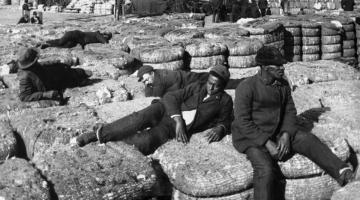

 In this week’s segment, we have an update on the US/Israeli war of aggression against Iran, from a journalist reporting from Iran. But we begin with a discussion with two organizers of the Pan-…
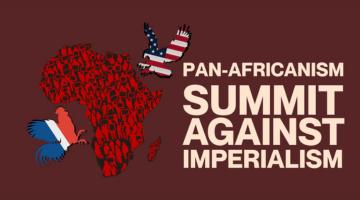 The Pan-Africanism Summit Against Imperialism (PASAI) will be held on May 11 and May 12 in Nairobi, Kenya. It is organized as a counter-summit to the France-Africa summit taking place in Nairobi at…
 Navid Zarrinnal is an Iranian journalist and host of The Colony Archive podcast. He joins us again from Iran to discuss the fragile "cease fire," Trump's threats, the Strait of Hormuz, and how Iran's…
 Beliefs in white supremacy and manifest destiny are at the heart of Donald Trump’s actions and his appeal to millions of people.
 “The ever-scheming European imperialists wisely placed Israel where she could geographically divide the Arab world…and also divide the Africans against the Asians.”