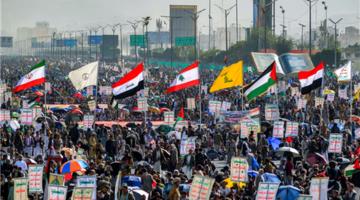
Protesters, predominantly members of the Shia community, shout slogans during a protest outside the US consulate in Karachi on 1 March 2026, after the killing of Iran's supreme leader, Ayatollah Ali Khamenei, in US-Israel strikes on Iran (Asif Hassan/AFP)
Anger erupted across the country, which is home to a large Shia population that viewed Khamenei as their spiritual leader.
Originally published in Middle East Eye.
At least 23 people were killed in Pakistan on Sunday as protests erupted across the country in reaction to the US-Israeli killing of Iran's supreme leader, Ayatollah Ali Khamenei.
At least ten were killed in Karachi, where hundreds of protesters charged the US consulate in the commercial capital of the country, with several managing to break through the outer gate and damage windows in one of the main buildings.
Protesters clashed with security personnel who deployed live fire, tear gas and rubber bullets at the crowds, injuring at least 60, according to a statement from Sindh's chief police surgeon, Sumaiyya Syed.
It's unclear whether US security personnel were responsible for the deaths or the Pakistani police forces present at the protest.
In the capital, Islamabad, at least two people were killed during a demonstration near the "Red Zone", a heavily guarded area containing the parliament and "diplomatic enclave" - within which the US embassy is located.
Thousands of protesters showed up in Islamabad to register their anger at the killing of Khamenei.
Pakistan, a country with over 200 million people, is predominantly Sunni Muslim, but at least 20 percent of the country identify as Shia Muslims and regularly make religious pilgrimages to Iraq and Iran.
Much of Pakistan's Shia community viewed Khamenei as their spiritual leader.
The US embassy in Islamabad on Monday had not directly addressed on the social media platform X the violence at their facilities, but announced it would be cancelling all visa appointments and consular services for American citizens.
On Sunday, the X account said it was "monitoring reports of ongoing demonstrations at the US Consulates General in Karachi and Lahore, as well as calls for additional demonstrations at US Embassy Islamabad and Consulate General Peshawar."
"We advise US citizens in Pakistan to monitor local news and observe good personal security practices, including being aware of your surroundings, avoiding large crowds, and ensuring your STEP registration is up to date."

Police walk past a burning armoured vehicle set on fire by protestors outside the US consulate in Karachi after the killing of Iranian Supreme Leader Ayatollah Ali Khamenei, on 1 March 2026 (STR/AFP)
The mountainous north of the country was another flashpoint of violence, where at least eleven people were killed in Skardu, a city in the picturesque tourist hub of Gilgit-Baltistan.
Protesters set fire to the office of the United Nations Military Observer Group in India and Pakistan. Authorities reacted by implementing a three-day curfew in the region. Gilgit-Baltistan is home to a large population of Shia Muslims.
On Sunday, Pakistani Interior Minister Mohsin Naqvi urged Pakistanis to remain calm.
“After the martyrdom of Ayatollah Khamenei, every citizen of Pakistan is saddened in the same way as the citizens of Iran are grieving,” he said.
"We request the citizens not to take the law into their hands, and to record their protest peacefully.”
Protests also took place in Lahore, Peshawar and other cities across Pakistan, and the death toll is expected to rise due to the nature of some of the injuries sustained by protesters.
Stuck in the middle
Pakistan has condemned what it called "unwarranted attacks" against Iran.
"Yet again, these attacks come at a time when renewed diplomatic efforts were underway to reach a peaceful and negotiated solution," Pakistan's permanent mission to the UN said in a statement. It also condemned the Iranian attacks against the Gulf nations of Saudi Arabia, Bahrain, the UAE, Jordan, Kuwait and Qatar.
The South Asian state finds itself in a precarious position as its neighbour to the west, Iran, is striking its allies in the Gulf. The Gulf countries and Pakistan have historical ties dating back to the founding of many of the Gulf nations, including military and economic ties.
Pakistan and Saudi Arabia signed a mutual defence agreement in September amid what was seen as increasing Israeli belligerence in the region after it struck Doha, Qatar, in an attempt to assassinate members of Hamas's political bureau.
Pakistan said the agreement “reflects the shared commitment of both nations to enhance their security and to achieving security and peace in the region", adding that the "agreement states that any aggression against either country shall be considered an aggression against both”.
Asked by Reuters, at the time, whether the agreement would place Saudi Arabia under Pakistan’s nuclear umbrella, a senior Saudi official said: "This is a comprehensive defensive agreement that encompasses all military means.”
Saudi Arabia and Pakistan have enjoyed close military ties for decades. The Financial Times cited a Saudi official saying that the agreement had been under discussion for two or three years.
It is unclear at the moment whether the agreement will compel Pakistan to come to Saudi Arabia's defence as it faces a barrage of attacks from Iran.

 The same caucus that celebrated the Emmett Till Antilynching Act refuses to condemn Israel's new death penalty for Palestinians.
 The UN has finally called the transatlantic slave trade the gravest crime against humanity. But the resolution is not reparatory justice, and the nations that voted no or abstained show themselves to…
 Misogynoir, a term meant to name the specific violence against poor and working-class Black women is now being used as a shield for political elites.
 The United States operates as an internal colonial system. Black communities are treated like colonized territories, and the white working class is used as a tool to enforce that control.