As western powers push technocracy over sovereignty, Palestinian resistance movements warn that there can be no reconstruction without liberation.
Originally published in The Cradle.
In the aftermath of the devastating war on Gaza, the most pressing question is no longer about a ceasefire or reconstruction, but about who will govern the enclave.
This is a struggle over meaning, legitimacy, and sovereignty. Will the future of Gaza be shaped by its people, or by the same foreign powers that helped destroy it under the banner of “salvation”?
Every time the gates of ‘reconstruction’ and ‘aid’ are opened, the windows of sovereignty are slammed shut. What unfolds is a recurring colonial spectacle: a Palestinian political order remade under foreign supervision, where ‘political realism’ is promoted as a substitute for justice, and ‘technocracy’ is marketed as a sterile alternative to resistance.
The day after
Senior Hamas official Ayham Shananaa tells The Cradle that the war’s outcome cannot be measured by the standards of traditional inter-state conflict, but must be understood as “an existential struggle between a people seeking liberation and an occupation backed by the west.”
He says the very survival of Hamas in the political arena after the two-year war constitutes a strategic victory as Israel failed to achieve its stated objectives, even with unprecedented international backing.
This view is echoed by Palestinian Islamic Jihad (PIJ) official Haitham Abu al-Ghazlan, who affirms that “the resistance is now more entrenched than ever,” and insists that the true measure of victory lies not in material destruction, but in the failure of the Zionist project to displace the population and break Palestinian will.
Shananaa adds that the resistance “has imposed itself as a key actor that cannot be bypassed in any discussion about Gaza’s future,” arguing that its steadfastness transformed it from a purely military actor into a national project with a vision and strategy.
Most significantly, he adds, “this war marked a shift in global consciousness,” citing unprecedented solidarity with Palestinians, massive protests, and symbolic recognitions of the State of Palestine, all pointing to a deep shift in western public opinion about the occupation.
Reconstruction as leverage: The new face of occupation
International proposals for Gaza’s administration – whether in the form of a technocratic government or a transitional authority – are being sold as humanitarian necessities. In truth, they are little more than cosmetic rebrands of the old control mechanisms.
In this context, Abu al-Ghazlan stresses that any such proposal “must be the result of an inclusive Palestinian national dialogue, not foreign agreements or international tutelage.” He affirms that “reconstruction is a human right, not a political bargaining chip,” and rejects any attempt to link it to disarmament or restrictions on the resistance.
The politics of governance: Can resistance yield to technocracy?
One of the central debates now confronting Palestinian factions is whether resistance authority can morph into technocratic governance – whether the separation of security and political decision-making is possible or even desirable.
Shananaa is unequivocal: “The resistance’s arms are a red line as long as the occupation exists.” While Hamas does not oppose a civil administration to manage daily life in Gaza, he insists that the movement will not compromise on the core of its security apparatus.
Abu al-Ghazlan, speaking from the PIJ perspective (which, unlike Hamas, has no political agenda), affirms the same red line: “All peace processes that stripped the resistance of its weapons ended in more aggression and settlement expansion.”
What emerges is a shared formula: A civil government is possible, but sovereignty – particularly security sovereignty – remains non-negotiable.
The idea of a “temporary civil administration” may appear moderate, but in reality, it is governance without power – a managerial shell devoid of political agency.
This model seeks to govern Gaza, not liberate it; manage, not emancipate it. What Washington and Tel Aviv are trying to construct is a hollow Palestinian model that presents the illusion of “self-rule” under the ceiling of occupation.
Shananaa and Abu al-Ghazlan both emphasize that any future arrangements “must be based on protecting the rights of the people, not on foreign pressure.”
The term “national consensus” may sound appealing in rhetoric, but it often functions as a mask for political illusion. True consensus requires real sovereignty and independent Palestinian will, while externally imposed consensus is merely renewed tutelage in disguise.
The survival equation: Hamas, legitimacy, and the resistance street
While the Palestinian Authority (PA) chases lost legitimacy through donor channels, Hamas draws its authority from survival amid the rubble. The people of Gaza – though exhausted – see in Hamas not perfection, but defiance, a refusal to capitulate in the face of annihilation.
On the question of a national unity government spanning Gaza and the occupied West Bank, Shananaa says this proposal is not new. Hamas has long called for real national partnership, he says, referencing repeated reconciliation attempts with Fatah in Cairo, Algiers, Moscow, and notably Beijing.
However, none were implemented because of PA President Mahmoud Abbas’s refusal to share power or accept a balanced framework, he explains:
“Hamas does not object to the Palestinian Authority playing a supervisory or financial role in reconstruction arrangements, as long as this is done within clear agreements that preserve the resistance’s arms and prevent any foreign interference in security decisions.”
Abu al-Ghazlan adds that trust between the PA and the resistance “cannot be built with words, but with positions. When the people feel that the political decision protects the resistance and does not constrain it, then we can say we have begun the path to rebuilding national trust.”
Gaza’s future appears confined to three possible scenarios, shaped by the power balances established by the war and the scope of international and regional interventions in shaping the so-called “day after.”
Scenario 1: Resistance-led governance – Hamas fills the vacuum
This is the most likely outcome, with a probability of around 60 percent. It rests on the principle of “imposed reality,” where Hamas reasserts its grip on Gaza in the vacuum left by the Israeli military’s withdrawal from the Yellow Line areas.
From the first day of the ceasefire, Hamas’s National Security Forces redeployed in streets, intersections, and liberated zones, visibly re-establishing a security architecture that had partially collapsed during the war.
Shananaa makes this clear when he confirms that “about 70 percent of the strip is under the control of Hamas-formed Palestinian security forces,” reflecting a field reality that cannot easily be overturned.
This scenario implies that the strip will remain under Hamas’s political and security administration for at least one to two years, until internal and external understandings mature enough to form a national unity technocratic government acceptable to both Palestinian and international actors.
This phase would amount to “transitional rule by force” – a hybrid of resistance authority and provisional civil administration, pending a wider political statement.
Scenario 2: Pre-2005 redux – security coordination and foreign oversight
Favored by the US and some regional powers, this scenario (estimated at 25 percent likelihood) envisions a return to pre-2005 arrangements: tripartite coordination between the Israeli occupation, the PA, and a US-led supervisory body – possibly with Egyptian and Qatari backing.
In this framework, “internationally acceptable” Palestinian forces would oversee Gaza’s administration, border security, disarmament efforts, and aid distribution under a central international committee.
But this vision collapses under two contradictions:
First, Hamas has no intention of surrendering its political or military position after surviving the war and forcing a ceasefire.
Second, years of security collaboration with the occupation have left the PA with zero public trust.
In short, this remains a western fantasy, not a viable roadmap.
Scenario 3: Engineered chaos – a controlled descent into conflict
The least probable scenario (15 percent), but the most dangerous, foresees a relapse into armed clashes among Palestinian factions – or between resistance groups and Israeli-backed militias, or the occupation army – if the ceasefire collapses or political negotiations falter.
This is Tel Aviv’s preferred outcome, as it ensures ongoing attrition of the resistance and keeps Gaza in turmoil, preventing the formation of any stable or unified political order.
Nonetheless, despite its risk, this scenario is unlikely in the near term, as regional actors – especially Egypt and Qatar – are working intensively to prevent a new explosion that could dismantle what remains of the political process.
Tel Aviv’s political implosion: Netanyahu’s fall and the crisis of Zionism
Israeli Prime Minister Benjamin Netanyahu wanted to etch his name into history as the man who crushed Hamas. Instead, he may be remembered as the architect of his own downfall – a view echoed even within Israeli political circles, from Yair Lapid to Bezalel Smotrich and Itamar Ben Gvir.
The ceasefire agreement was, in effect, an admission of Zionist failure. The war’s goals – eliminating Hamas and freeing captives by force – evaporated in the face of resistance.
Even if Netanyahu goes, the Israeli security and political establishment will still seek control over Gaza, but without the unified narrative that once justified killing in the name of survival.
Shananaa says the ceasefire agreement deepened Israel’s internal crisis and weakened the cohesion of the far-right coalition, describing Netanyahu’s government as “a fascist, extremist one that has lost legitimacy even inside Israeli society.”
“More than 1.5 million Israelis protested against the war, and the opposition grows by the day. American support is what keeps Netanyahu politically alive, but his fall is only a matter of time.”
The war’s aims shifted from “eliminating Hamas” to “surviving failure.” It was a descent from strategic vision to tactical reaction; from a state making history to a state struggling to survive its own present.
In the end, the question ‘Who rules Gaza after the war?’ is an existential one rather than an administrative one. Who holds real legitimacy? Who defines the future? Who decides when the war ends?
Shananaa answers clearly. “There is no authority above the resistance, and no reconstruction without sovereignty.”
Legitimacy is not awarded by donors or imposed through frameworks. It is forged under fire, seized from the rubble. And the “day after” will not begin with signatures, but with the dismantling of the occupation.
Dr. Mohammad al-Ayoubi is a Palestinian writer and researcher holding a Bachelor's degree in Journalism and Media Studies and a PhD in Law.

 In this week’s segment, we have an update on the US/Israeli war of aggression against Iran from a journalist reporting from Iran. But we begin with two organizers of the Pan-Africanism Summit Against…
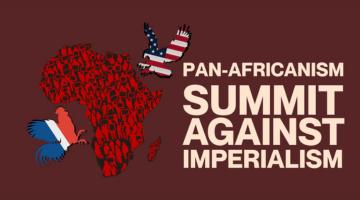 The Pan-Africanism Summit Against Imperialism (PASAI) will be held on May 11 and May 12 in Nairobi, Kenya. It is organized as a counter-summit to the France-Africa summit taking place in Nairobi at…
 Navid Zarrinnal is an Iranian journalist and host of The Colony Archive podcast. He joins us again from Iran to discuss the fragile "cease fire," Trump's threats, the Strait of Hormuz, and how Iran's…
 Beliefs in white supremacy and manifest destiny are at the heart of Donald Trump’s actions and his appeal to millions of people.
 “The ever-scheming European imperialists wisely placed Israel where she could geographically divide the Arab world…and also divide the Africans against the Asians.”