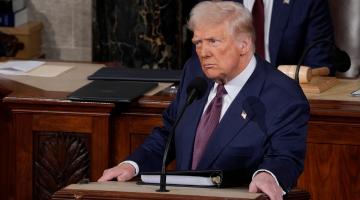
US President Donald Trump. (Photo: video grab)
Donald Trump recently made several statements declaring his intent to commit a full-scale ethnic cleansing of Palestine's Gaza Strip. However, this idea, like many others, may be unfeasible and without the support needed to be enacted.
Originally published in Ramzy Baroud.
Just as nearly a million Palestinians began returning to their destroyed region in the northern Gaza Strip on January 27, US President Donald Trump began speaking of something else entirely: ethnically cleansing Palestinians outside of Gaza.
His statements, which he repeated on multiple occasions, were typical of Trump’s speeches: riddled with inaccuracies, confused, and largely detached from reality.
He claimed to have spoken with Jordanian King Abdullah II and Egyptian President Abdel Fattah el-Sisi and that they had agreed to transfer the population of Gaza to their own countries—a demand that was forcefully rejected by both countries throughout the Israeli genocide in the Strip, which began on October 7, 2023.
“I said to him (King Abdullah II),” Trump told reporters aboard Air Force One, “I said to him that I’d love you to take on more (Palestinians), because I’m looking at the whole Gaza Strip right now, and it’s a mess. It’s a real mess.”
A call to the King had, in fact, taken place, according to Jordan’s state news agency, Petra, but there was no mention of relocating or ethnically cleansing Palestinians under any pretense.
Jordan, like Lebanon and other Arab countries, is always wary of demographics, especially as an estimated 2.39 million registered Palestinian refugees already live in the Kingdom. Regardless of Jordan’s reasons behind its rejection of the proposal, the country is firm about refusing to accommodate Trump’s political whims and incoherent logic.
A similar conversation had allegedly taken place, this time between Trump and Egypt’s Sisi. “You’re talking about a million and a half people, and we just clean out that whole thing,” Trump claimed to have said.
“I don’t know, something has to happen, but it’s literally a demolition site right now. Almost everything’s demolished, and people are dying there, so I’d rather get involved with some of the Arab nations and build housing in a different location where I think they could maybe live in peace for a change,” he added.
It is important to note that the ‘demolition’ of Gaza and the fact that “people are dying there” was a process that was facilitated and supported by the US government.
Trump went further, suggesting that housing Palestinians in Jordan and Egypt “could be temporary” or “could be long-term.”
Though Trump is known for making contradictory statements, often within minutes of each other, if not within the same sentence, this time around, he doubled down, returning to the same subject on January 30.
Answering a question from a reporter, he said, “They will do it. They will do it. They’re going to do it, okay? We do a lot for them, and they’re going to do it.”
This confident comment came despite the insistence by both Jordan and Egypt that no such conversations had taken place and that no displacement of Palestinians would be allowed.
To emphasize the point once again, Arab foreign ministers issued a joint statement in Cairo on February 1, reaffirming total support for Palestinians and their legitimate rights under international law.
As if to leave no room for doubt, the statement said that Arab governments renew their “rejection of (any attempts) to compromise Palestinians’ unalienable rights, whether through settlement activities, evictions, annexation of land, or vacating the land from its owners … in any form or under any circumstances or justifications.”
One could have easily ignored Trump’s comments as irrelevant, detached, and based on false claims of having any real knowledge of the current political mood of the Middle East following the ceasefire—let alone of the region’s history, culture, and politics.
His insistence, however, forces us to take the comments more seriously.
Unlike the collective panic that struck many Palestinians and their supporters during the 471 days of genocide, when the ethnic cleansing of Palestinians was indeed a top Israeli priority and was tacitly entertained as a possibility by the US administration, this time around, fears have largely dissipated.
While Israel would like to see all Palestinians ethnically cleansed from their historic homeland, in a repeat of the Nakba of 1948 and the Naksa of 1967, Israel’s military defeat in Gaza makes such a goal unachievable.
To the contrary, the Palestinians have succeeded, thanks to their collective resistance, in returning to northern Gaza, and a new culture is already emerging among the Palestinian people where the idea of honoring the Right of Return for Palestinian refugees to historic Palestine no longer seems unrealistic—as many have erroneously argued.
So, yes, one can argue that Trump, who knows very little about the Middle East and even less about Palestine and Gaza in particular, is detached from the unfolding events and the shifting collective psychology of the region.
But that is not enough to explain the timing of Trump’s comments or, more importantly, his insistence on making such strange remarks.
There are several reasonable explanations for why Trump made these comments or was advised to do so by pro-settler movement politicians within his administration:
First, Israel received a massive blow in Gaza. Despite the genocide and the destruction of the entire Strip, the Israeli army was humiliated. Its gradual exit from Gaza has dashed hopes among Israel’s settlers that they can rebuild their illegal settlements in a re-occupied Strip.
Among those settlers is Miriam Adelson, the wife of the now-deceased pro-Israel billionaire Sheldon Adelson. She has reportedly donated $100 million to Trump’s campaign and remains one of his greatest financial backers.
It is possible that Trump’s statement was an overture to Adelson or a last desperate attempt by her to see if the dream of ethnically cleansing Palestinians could be achieved through US pressure on Jordan and Egypt.
Second, the timing of the statement created a much-needed distraction for Israel and occupied much of Middle Eastern media headlines.
While Palestinians were returning to northern Gaza, singing about their unprecedented victory—which took place despite unhinged US backing of the Israeli genocide—Washington wanted to create a distraction from the Palestinian triumph.
Needless to say, Trump’s blabbering achieved nothing aside from further diminishing the image he tried to create for himself as the strong leader capable of stopping wars with a single telephone call, as he has often claimed.
In fact, Trump had succeeded, however temporarily, in convincing some Arabs—as expressed in the views of analysts and media commentators—that his pressure on Netanyahu had ended the war. His nonsensical statements about ethnically cleansing Palestinians quickly depleted whatever political capital he had undeservedly earned.
Finally, Trump may have hoped to use the threat of the ethnic cleansing of Palestinians as a pressure card on the Saudis to normalize relations with Israel, as he did with the UAE normalization on September 15, 2020. In the latter case, the UAE normalization was promoted as being done in exchange for delaying Israel’s plans to illegally annex large parts of the occupied West Bank. Thus, the normalization was sold as being done for the sake of Palestinians—to deter Israel from annexing the occupied region.
Of course, that was a ruse, and Israel made no such commitment. Does Trump believe he will be able to reignite normalization efforts between Israel and Saudi Arabia in exchange for abandoning his discourse on ethnically cleansing Palestinians?
If that is indeed his intention, then his plan will not gain much traction. If 471 days of Israeli genocide failed to ethnically cleanse Palestinians, Trump’s incoherent speech scares no one.
Trump and his new government of pro-Israel extremists must realize that the Middle East of today is different from the one that rushed to normalize relations with Israel during his first term.
The decisive factor in that change is not the degree of Israeli violence in Gaza and the attempt at exterminating the Palestinians, as concluded by the International Criminal Court, but the fact that the Palestinians have wrested the most precious victory ever scored by an Arab nation against Israel.
This victory, especially one achieved not by a traditional army but by the people themselves and their homegrown resistance, has centered Palestine once more as the main driving political issue for all Arabs.
Trump has yet to understand this, and, judging by the crowd of extremist politicians around him, he most likely never will. What matters, though, and what should come as a great relief to many, is that the decisions regarding Palestine and the future of the Palestinian people are back in the hands of the Palestinians themselves—probably the greatest achievement of the Palestinian struggle since the Nakba nearly 77 years ago.
Dr. Ramzy Baroud is a journalist, author and the Editor of The Palestine Chronicle. He is the author of six books. His latest book, co-edited with Ilan Pappé, is ‘Our Vision for Liberation: Engaged Palestinian Leaders and Intellectuals Speak Out’. His other books include ‘My Father was a Freedom Fighter’ and ‘The Last Earth’. Baroud is a Non-resident Senior Research Fellow at the Center for Islam and Global Affairs (CIGA). His website is www.ramzybaroud.net



 The same caucus that celebrated the Emmett Till Antilynching Act refuses to condemn Israel's new death penalty for Palestinians.
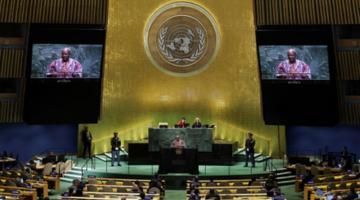 The UN has finally called the transatlantic slave trade the gravest crime against humanity. But the resolution is not reparatory justice, and the nations that voted no or abstained show themselves to…
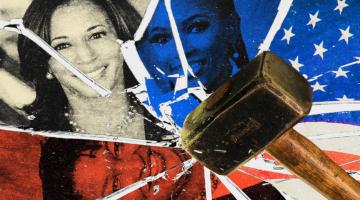 Misogynoir, a term meant to name the specific violence against poor and working-class Black women is now being used as a shield for political elites.
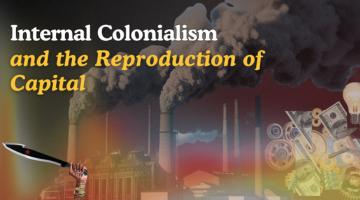 The United States operates as an internal colonial system. Black communities are treated like colonized territories, and the white working class is used as a tool to enforce that control.