Chavez is surrounded by supporters upon his return to the presidential palace after a coup attempt on April 14, 2002. (Photo: AFP)
The 2002 attempted coup against Venezuelan president Hugo Chavez was undone because of popular action. The Bolivarian Republic recently held an international summit commemorating events which defied the U.S. and kept the elected government in power.
From April 11-13, 2022, the Bolivarian Republic of Venezuela hosted the "International Summit Against Fascism" in Caracas. Two hundred journalists and activists from five continents attended the summit, where the 20th anniversary of the short-lived coup d'état against Hugo Chávez was commemorated. in the context of the importance of media in movements and as a milestone in the continued fight against the global consolidation of right-wing political forces and rising fascism.
The three-day event featured panel discussions about the right-wing forces the people of Venezuela defeated in 2002 compared to the fascist elements operating in countries across the Global South, and now in Ukraine, as well as the relevant emergence of fascism in the United States that emanates from both political parties to support dictators and police states.
Popular communication and the role of media were extensively discussed, as the complicity of the Venezuelan media was recalled in several panel discussions. The coordination of all major Venezuelan media outlets to disseminate the lie that former President Hugo Chávez had relinquished his presidency in 2002 was not only recounted as part of the timeline of events of the overturned coup but also compared to the present consolidation of US media and those of its allies regarding the proxy war in Ukraine. The willingness of media CEOs and news anchors to lie to the people of Venezuela in 2002 seemed to be an omen for what was described as the media dictatorship that is spinning an equally false narrative about Ukraine right now.
The Venezuelan media was not the sole topic in the examination of the 2002 coup attempt. The United States government’s support of the violent and undemocratic right-wing in the country was also a common theme raised by many presenters. The role of members of the US foreign policy team such as then Secretary of State Colin Powell and CIA Director George Tenet whose demonization of Chávez in hearings before Congress set the stage for US intervention in Venezuela. Chávez - who had been president for just two years at the time of the coup - had committed two unforgivable offenses:
- He held meetings with the leaders of the sworn enemies of the US: Cuba, Iran, and Libya, and
- He criticized the US response to 9/11 in Afghanistan
Kidnapped by the fascist plotters in the government and facilitated by the media, Chávez was secreted away and held captive for two days while the Venezuelan people were told that there was a new president in town. But if that were the end of the story, there would have been no need for this conference.
While the play-by-play of the coup revealed details that most Americans had surely never heard before - such as how all the media outlets declared there was a new government in place on the morning, but played nothing but cartoons on every station for the rest of the day while the coup government was hastily being legitimized. The most fascinating and important aspects of this important historical event was the role of communication among the people in returning Chávez to power and restoring the constitutional democracy that the people shaped under him.
During the panel on Popular Resistance and Response, Yesenia Fuentes, president of the Association of Victims of April 11, recounted how she - a poor single mother - heard from neighbors that the media had lied, that Chávez had not resigned and was still president. Having not been particularly political before Chávez, Fuentes said she joined her neighbors and countrymen who took to the streets marching toward Miraflores - the presidential palace - to demand the whereabouts of the president they elected in a landslide just two years earlier.
It is important that Fuentes survived being shot in the face by Venezuelan soldiers ordered to open fire on the people. But what might be more important in a purely political sense is that Fuentes and tens of thousands of Venezuelans took to the streets in defiance of the intense media propaganda, in defense of deadly fascist violence, to demand that the constitution the people helped shape after the landslide election of Hugo Chávez be restored. Yes, the people wanted their president back, but they were fighting for the democracy they shaped even more.
And this was the context in which the people appealed to the military to join them in demanding the release of President Chávez two days after he was kidnapped. Media images from the people flooding the streets, pressing against the gates of Miraflores, the Presidential palace, with signs demanding to know, “Dondé está Chávez? Que hablas! - Where is Chavez? What do you say?”
These details and others about how popular resistance among the people overturned the first-ever media-led US-backed fascist coup in 2002 were shared during the panel, which also connected that history with the need to commit to and expand popular communication today.
The challenges facing popular communication were raised in panels involving current Venezuelan journalists who talked about World War 2.0: Digital Political Communication In Globalization. They focused on the power of social media and independent media in the struggle against global fascism and its rapid consolidation. The coup in 2002 was an example of how media consolidation was used to subvert the will of the people then, and how media consolidation does the same thing today.
To accentuate that point, Ukrainian journalist Liubov Alexandriana Korsakov presented details about the 8-year civil war that has been raging in the Donbas region. She spoke of media silence on that war, including complicity in crafting a false narrative about the Russian military action in Ukraine. At the end of her presentation, she held up a flag of the Donbas militia, emblazoned with the letter Z - and urged continued support and journalistic attention on the fight against fascists in the Kiev army who were armed and legitimized by the US. A flag and a letter, incidentally, that have been banned in Kiev by the so-called democratic government of Volodymyr Zelensky.
Attending Militia Day celebrations was a disconcerting experience since in the US citizens’ relationship with the police and military is not an amicable one, even though many of them come from the working class and poor masses. However, the legacy of April 11-13 as well as the Bolivarian Revolution reshaped the relationship between the people and the military. Carlos Ron, Venezuela’s Vice Minister of North America, shared the story of how the famous letter from President Chávez was delivered to the people. A young soldier heard from the media that Chávez had resigned. Tasked with guarding the kidnapped president, the soldier asked Chávez if it was true, if he had really resigned. Chávez answered that he had not and he never would do such a thing. The soldier convinced Chávez to write a letter, sign it, and put it in a nearby trashcan because no one would look for anything there. He would retrieve the letter and get it to whomever Chávez told him to. Letter in hand, the soldier delivered it to the former Attorney General, but then went on to tell his fellow servicemen that the news about Chávez resigning was a lie, and he had proof.
Meanwhile, the Attorney General took the letter to the media and uttered one sentence, “President Chávez has not renounced,” and that was enough to send the people into the streets to defend their constitution and demand the return of Chávez. But on the way, they were met by soldiers and pleaded with them to adhere to the constitution they also participated in shaping, and many did.
Therefore, Militia Day does not present the contradictions of the military being agents of the state who are against the people as they operate in the US. Despite whatever internal struggles and contradictions they experience, the military largely supported and continues to support the Bolivarian Revolution that they were key in restoring on April 13.
President Nicolas Maduro commemorated April 11 with a press conference to honor the people’s popular resistance to the coup, with the attendees of the summit as his special guests. President Maduro sat behind a remarkably simple long desk with a portrait of Simon Bolivar and the Venezuelan flags adorning the podium as he recounted the deep history of April 11-13, complete with showing relevant newsreels and providing several well-timed and sharply pointed jabs at the coup-plotters and their backers in the US. But even as he recounted the steps leading up to the coup and how it was overturned by popular resistance and communication, he took the opportunity to not just focus on Venezuela’s struggle, but to offer solidarity to Chilean victims of fascist police violence in the city of Renato, and offered the same assistance to Colombians suffering the same fate.
The current struggles in Venezuela against ongoing US repression are not disconnected from Hugo Chavez; he is not in the past, but he is very present in the consciousness of the people he focused on the most - the Indigenous, Afro-Venezuelans, peasants in the mountains, and the poor in the barrios in the hills above Caracas and those throughout the country.
The Cuartel 4F and museum - the final resting place and museum for President Chávez - is located among the people in the mostly poor barrio of the Monte Piedad sector where he tried to wage his armed struggle against the fascist government of Carlos Andrés Pérez in 1992. After being pardoned from prison in 1994, Chavez started the Fifth Republic Movement which was more centrist than revolutionary, but was focused on lifting those Venezuelans who had been left out of the political process and society up and bringing them into participating in a new kind of government.
Visiting the museum at the Cuartel de 4F where his body lies in a marble-encased tomb surrounded by ceremonial guards and reflective pools of water, Chavez’s grassroots political education in the speeches he gave in those neighborhoods on flatbed trucks, speaking to people in forgotten villages in the mountains, and in the middle of the most impoverished barrios in the cities is showcased. Inspired by his desire to free all Venezuelans from poverty, inequality, oppression, and political isolation, the people voted in record numbers to put Chávez in the presidential office in 2000, and as a result one of his first acts was to immediately begin the process of including the people who voted for him in rewriting the country’s constitution. This was the beginning of the Bolivarian Revolution, and the coup in 2002 was designed to stop a true people-powered and focused state from taking shape.
Walking through the new exhibit commemorating April 11-13, the sights, sounds, and lessons of that time illuminate how Chávez’s revolution spurred the people to defend their new democracy against the most powerful fascist state in the world. The inspiration he drew upon - from his own upbringing as one of the forgotten poor in a small village to his faith in Jesus Christ as a force for social equality and liberation, his commitment to protecting the people and environment they live in - was on full display to erase any confusion about the ability for those concepts of faith and revolution to co-exist successfully. They did in Chávez and they still do in many Venezuelans who will openly weep if asked how they feel about their Comandante.
At the end of the summit, the phrase, “The people, united, will never be defeated” takes on a whole new and relevant life, and the word democracy has a legitimate meaning.
Because Venezuela continues to prove that statement to be true.
Jacqueline Luqman is co-host of By Any Means Necessary on Radio Sputnik. She is also a contributor to The Real News Network, Editor-In-Chief of the social media program Luqman Nation, and a contributor to Black Power Media. She has more than 20 years of activism in Washington, DC focusing on participating in and supporting community-level issues as well as regional and national issues that impact working-class, poor, and oppressed people in the US and abroad. She is a member of the Black Alliance for Peace, Pan-African Community Action, is a supporter of several other grassroots radical Black-focused and led organizations, and is an active member of the Board of Social Action in Plymouth Congregational United Church of Christ, a progressive church in Washington, DC.

 In this week’s segment, we have an update on the US/Israeli war of aggression against Iran from a journalist reporting from Iran. But we begin with two organizers of the Pan-Africanism Summit Against…
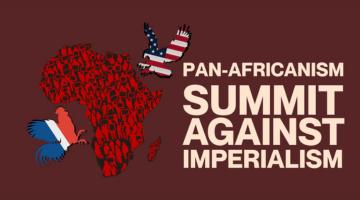 The Pan-Africanism Summit Against Imperialism (PASAI) will be held on May 11 and May 12 in Nairobi, Kenya. It is organized as a counter-summit to the France-Africa summit taking place in Nairobi at…
 Navid Zarrinnal is an Iranian journalist and host of The Colony Archive podcast. He joins us again from Iran to discuss the fragile "cease fire," Trump's threats, the Strait of Hormuz, and how Iran's…
 Beliefs in white supremacy and manifest destiny are at the heart of Donald Trump’s actions and his appeal to millions of people.
 “The ever-scheming European imperialists wisely placed Israel where she could geographically divide the Arab world…and also divide the Africans against the Asians.”